Sunday, June 30, 2019

Hasta

I haven't posted to this space in ages, mostly because I haven't had the time. Over the past 3 years I’ve been attempting to balance work, family life, and my PhD studies in education at McGill University. All of those things are great individually, but taken together, it's too much.

In the past months I’ve done a lot of thinking about where I am and where I’m headed. This reflection was sparked by changes to how the university effectively funds its graduate students, which would negatively impact me as an international student employed outside the university. I could likely receive an exception to these requirements, but the move prompted me to reflect on other aspects of what I’m doing and where I’m headed.

One of the things that I’ve been thinking a lot about lately is what would happen when I finish my PhD. When I started this program I dreamt of landing a tenure-track job at a university. My program has trained me for such a role: that of a research and educator. Over the past year I've realized that I’d rather be a teacher at a small college. Regardless of which type of post-secondary institution I aim for, the likelihood of obtaining a position right out of grad school is relatively slim. More likely, I would have to do at least one post doc to bolster my resume and accrue the necessary experience to be able to put together a competitive application for one of the relatively few jobs out there. And there’s lots of qualified peeps! The other limiting factor for me is geographical. I love where I live, we have family here and deep roots. The more that I thought about it, I’d like to be able to find a way to do meaningful work without re-locating my family.

I was chatting with a family member this spring and they asked about my endgame. I described the possibility of working at a semi-local (~1 hour commute) college and what that might look like. This person listened to my story and then repeated back what I'd said. They noted that, to them, it sounded like the best possible outcome would be me working at a college within the SUNY system to preserve my retirement. My family member pointed out that I’d be driving at least six additional hours every week to make that happen. They then asked me if that something I really wanted to do.

At first I thought that the answer was yes, but the more I reflected on it, I don't want to spend that much time driving and being away from home. So this got me thinking – if completing my PhD is likely to require significant financial hurdles as well as doing lots of difficult (but fulfilling!) work that would require me to carve out time away from my family, and the position I get in the end might not be the best fit for us – why am I doing this? 

To me there are two answers. The first response is that I’m interested in the work, I enjoy it, and it needs to be done. The second answer, if I'm being honest with myself, is ego. I’d like to be able to say that I did this really difficult thing and that I contributed to the field in an important way.

The story I've been telling myself for so long is that doing a PhD is important and that it's worth everything I'm putting myself and my family through. I've been questioning that since I talked to my family member. When I mentioned this conversation to my wife, she admitted the same thing: this has been rough. When I voiced my doubts about moving forward, she echoed the exact same sentiments and asked if there were other ways I might be able to effect change.

Two recent developments interactions have shown me that I have the power to do more in my current role. The first revelation came from an exchange with a scholar working at an R1 university who visited my classroom. They were surprised by the depth of the connections that I had with my students. They told me that they don’t have those kind of deep conversations with their students and that they don’t know them that well. In that moment I realized that getting to know my students is something that I really value. From my previous leave of absence, I know that I missed working with students dearly, and somehow never imagined that it might be the norm if I moved to a post-secondary setting. The other significant development is that over the past three years I’ve become involved with the underrepresentation curriculum project (underrep.com), both with my physics students and as an editor. Over the past year I’ve had a couple of opportunities to do work and present on behalf of our collaboration. This has been really powerful – the conversations are never perfect, but being able to make a difference and being recognized for my experience has been a revelation. This makes me feel that being "just" a high school teacher is far from the end of the world, and I’m optimistic that I can find ways to effect change in significant ways without a PhD.

As you can probably get by this point, here is the decision: I’m withdrawing from my PhD program. It’s in the best interest of my family, who have long had to put up with me disappearing for long chunks of time to write and wandering around in a zombie-like state due to staying up late. I can always return to the PhD in the future. Maybe down the road I’ll have more time to devote to it, but for now I'm more than happy to bring all I learned in the PhD program back to my classroom. I’ll be forever thankful for what I learned from my supervisor Allison Gonsalves. I also learned tons from the professors and my fellow graduate students at McGill. Also, thanks to the folks at Saranac Lake Central School District, who have been incredibly accommodating in giving me the space to do this work. Finally, I couldn’t do this without the support my family, I am so excited to have more time to hang out with y’all!

Look for (slightly) more frequent blog posts in the future. Thanks for listening!
Hasta,


Chris

Tuesday, August 28, 2018

Addressing under-representation in physics

While reading a recent edition of the Gazette (https://t.co/swkv7bYAMz), which is published by APS, three quotations resonated with me.

"If our field [physics] is to attract the best minds and retain the best minds, then we must create environments that individuals with the best minds want to join and continue to support" (Cochran & Scarlett, 2018).

"We are here for the love of the field, but often the field does not love us back... We need to stop thinking that STEM lives in isolation... Our ignorance, or lack of interest, in social construction is no longer an excuse." (Ximena, 2018)

"The goal of creating diversity and inclusion in the field of physics will not be accomplished
by only increasing numbers of individuals from different social and cultural backgrounds or marginalized groups. Inclusiveness is generated by welcoming and providing a safe place to allow uncomfortable discussions that challenge the existing state of affairs" (Adenola, 2018).

Taken together, these works eloquently align with my thinking on these issues. Reading these scholars' work prompted me to put some of my beliefs in writing. They are:

0) The under-representation of non-dominant groups in physics is a massive problem (obviously).

1) The lack of people from particular backgrounds in physics is not the fault of individuals, but rather points to pervasive problems with the culture of physics itself.

2) Adding more folks who identify with under-represented groups to physics is unlikely to do any good, as the problem is with the culture which is (re)produced & (re)created by the dominant bloc within physics: White, heterosexual, able-bodied, middle class men (full disclosure- I fit this description of an insider).

3) The best way we have so far identified to create changes in classroom cultures of physics is to have explicit conversations about under-representation with students. I believe that such conversations help to both produce new cultures of physics which are more inclusive and equitable, and also helps students reimagine "who" is capable of doing physics.

4) Insiders such as myself need to lead the charge to change physics. Not because we know the first thing about how people who identify with non-dominant groups experience physics (we don't know jack), but because it's our culture that is the problem.

These beliefs have led me to the under-representation curriculum, which I am honored to be a part of. We're a group of folks working to create and distribute a modular curriculum that teachers can use to facilitate the sorts of conversations about under-representation described above. Check it out at: http://underrep.com/ or follow #UnderRepSyllabus on twitter.

More to come- stay tuned!

Wednesday, February 14, 2018

Switching it up

This year I started my class differently than I ever have before. We did the same goofy opening day exercises and name game that I always do, but I didn't hand out a syllabus. Instead I told my Financial Math students that we'd get to it the next day. This was an experiment of sorts- since it was my first time teaching the course and I only had one section of the class, I thought that we would try something different based on what I'd learned in my graduate courses about giving students a more active role in their learning (e.g. Basu, Barton, Clairmont, & Locke, 2009; Seiler & Gonsalves, 2010)

The following day I still didn't hand out a syllabus. Instead we started a conversation as a class about what we wanted to get out of the class. We talked about potential topics and skills that students were interested in (generally being able to manage their finances and make educated financial decisions in the real world). Once the broad goals of the course had been decided, we turned to how we were going to structure the course and began outlining a syllabus as a group.

Over the next few days we talked about what would constitute evidence of learning and how I could best quantify their performance (given that I am required to enter a numerical grade for each student every 5 weeks, this is inescapable). Together we came up with a list of how I could assess their learning: homework, weekly quizzes, end of chapter tests, occasional projects, and class participation. Then we decided on how much each category should be weighted. This was an insightful moment for me- the discussion about what matters more and what is "easier" to get was fascinating. The students tended to weight tests more than I would have otherwise, and wanted less emphasis on class participation than I would have assigned working on my own. I kept my mouth shut for the most part during this portion of the discussion and we ended up with a weighting that we could all agree on. 

The students also recognized that homework was necessary to practice their skills, but they didn't want it to be due every day. I agreed to this instantly and their jaws dropped; I don't think they expected that pitch to be successful! We decided on homework due twice a week - Wednesdays and Fridays- and no homework due right after a weekend. Also, as with previous courses, I make homework solutions available so that students can check their work and make sure they're on the right track rather than just become frustrated about their inability to solve a problem. I could share more details about the discussions we had, but this should be sufficient for now.

In effect we spend 2+ class periods ironing out the syllabus and how we wanted the class to look. After we finished our discussions, I went away and typed up my notes into a draft syllabus, which we reviewed as a class and then made final adjustments. This whole process felt a bit strange coming from other courses where I am perpetually pinched for time, but at this point in the year I can honestly say that it was some of the most productive time I have ever spent with students. Not only did it send a strong message to the students that they were going to be actively involved in the execution of the course, but it also set the tone for the entire year. And on the rare occasion when students complain about the course policies, they are met by their peers who call them out on not chiming in when they had the chance to craft them firsthand. Or, for students who entered the class late (more than 25% of the class joined more than 10 weeks into the year, but that's a story for another time), the message is quite different from what a syllabus conveys in a more conventional course. For example, in the past I might have handed a new student the syllabus and said something about it containing my expectations for the course. This year the students are told "this syllabus explains the way we decided to do things in this class." It's a subtle change, but a powerful one.

I'm far from the only teacher to do this, even in my school. Another teacher who has multiple sections of the same course goes through a similar process with each section. That sounds complicated to me, but I can clearly see the value in it. I don't think I can ever go back to handing out a syllabus I wrote on the first day or school- it's become clear to me this year that such an action runs counter to the goals of my teaching. It took a leap of faith for me to see this though, and I hope that by hearing about my experiences you might be emboldened to take such a leap for yourself.


References
Basu, S. J., Barton, A. C., Clairmont, N., & Locke, D. (2009). Developing a framework for critical science agency through case study in a conceptual physics context. Cultural Studies of Science Education, 4(2), 345–371.
Seiler, G., & Gonsalves, A. J. (2010). Student-Powered Science: Science Education for and by African American Students. Equity & Excellence in Education, 43(1), 88–104. https://doi.org/10.1080/10665680903489361

Friday, February 3, 2017

Giving voice and taking action

I feel lucky to be sitting here today writing this post. I'm buried in work and exhausted after a grueling day of class and a long drive home last night on snowy roads, but at least the barriers I faced over the past 48 hours were of my own making. I should probably be reading or writing, but on the other hand this needs to be said. And more importantly, I need to say it.

As I waited at the border last night to come back into the US, I began to get nervous. I've never had problems at the border, but things have changed over the last week. There were 4 cars in line. I didn't see what happened to the first one- I had put my car in park and was trying to get my voyzer app set to play the next pdf (if you drive a lot and have pdf's to read- it's a solid investment). The second car in line was sent back to Canada. The third car was sent for secondary inspection after a long exchange with the agent. I pulled up and wasn't sure what to expect. Within two minutes I was on my way home without a fuss. Was it my Nexus card? Study permit? The fact that I cross the border so frequently that I recognize many of the agents from previous interactions? Or did it have something to do with the color of my skin and the way I speak?

Yesterday I came into contact with a wide range of people from different places, which is one of the best things about McGill. In a single day I personally interacted with Canadians (of course), and Americans, but also people from Colombia, Taiwan, Saudi Arabia, Iran, Pakistan, Argentina, Brussels, India, Japan, and China. And those are just the homelands of people I know.

Two of my professors not only acknowledged the recent events that have caused distress for many students, but also provided space and time for a discussion. This meant the world to me- more and more I get the feeling that I am doing exactly the right thing in a place that is perfect for pushing me in the directions I need to go. Looking back I cannot imagine how my day would have gone without having had those opportunities, while recognizing that these conversations might not have happened at different institutions.

During these discussions I learned that my peers experience much of the horror, frustration, and fear that I do, but also that they are determined to fight against the forces that pull our world further toward racism, oppression, and violence. I learned that classmates had been urged by their families to abandon their studies and return home while they could still travel. Others have been forced to curtail their activities and modify their lifestyles to avoid putting themselves in harm's way. Collectively we struggle to console each other during these dark times, but I was heartened by the incredible sharing of experiences that were terribly painful. They strongly affected me and increased my resolve to take action.

I was urged yesterday to do what I can to resist in whatever way possible. That is why I write this post today. I am not from one of the countries affected by the illegal travel ban. I am not Muslim. I am not female, nor do I have colored skin. I am the veritable epitome of heterosexual white male privilege, and I today I use this privilege today to share experiences of others with an audience that they are unlikely to reach. I write today in confidence that I am not alone in how I feel about recent events and how they have affected people who have done nothing to deserve such horrible treatment.

I encourage all of you who happen to read this to act in whatever capacity you can. Share this post, talk to people who have different world views, sign a petition, attend a rally, stand in a vigil, point out propaganda when you see it- whatever you can do, please resist. For those of us with privilege, resistance takes effort but is unlikely to cause lasting damage. This is not the case for many, and because of our position in this world we must act.

Thursday, October 6, 2016

Pandora

Good day intrepid readers! For those of you who are wondering how my new gig is going, it's a bit like this: Reading, reading, and more reading, followed by lots of writing, then some driving while thinking about the readings. Repeat.
Not graduate work- can't forget to go play!
Seriously though, it's good. I feel like I finally have a breather- not from work, of course, I'm still wicked busy- but rather a breather in the sense that I finally have a chance to step back from the everyday life of a teacher to look at my actions and how they affect student learning. It's a really rich process to go through, and I realize that one of the biggest problems today for many teachers is that they're so busy and overworked that they never get the chance to see the big picture. For example, maybe it's not that critical that you get the next worksheet formatted just right or that you select the perfect question for a test, but rather the next thing you say to a student when you're in the middle of a discussion.

I'm working with some really neat folks. The DISE faculty are awesome, and hearing my fellow doctoral cohort mates introduce themselves during our first seminar was incredible. They're working on such cool stuff that it's impossible not to be stoked just being around them. I've already had more opportunities to practice my rusty Spanish than I've had in ages- and with native speakers no less! I've also been hanging around a bit with the SALTISE research group, which is doing some incredible things with technology.

Mad props to LaTeX as always, started using BibLaTeX and it's slick, especially when paired with Zotero.

I'd like to close by saying thanks to my former students for coming up with some many great Pandora stations. Whenever I feel like my options are getting stale, I open up one of the random creations we listened to during class. Right now I'm on the Superman station (classical scores), but earlier today I was jamming to Caravan Palace. And though this might be sacrilege to my AP students, I haven't touched the smooth jazz station yet- I'm keeping the big guns in reserve!

Friday, July 22, 2016

Social Justice in the Physics Classroom

In the spring of 2015 I read a series of blog posts about teaching social justice in physics classes. At the time I wasn't in a position to implement it (the NYS Regents exam in physics doesn't leave a ton of space for extra topics, particularly when using the Modeling curriculum as I do). This year however, I wanted to do something special with my AP Class after their exam. We had a brainstorming session and were throwing around ideas for fun projects. A rube goldberg machine, battle bots, etc. Then I added social justice to the list.

The students wanted to know what I meant. I told them that I was interested in discussing race in physics. The students immediately wanted to know what I meant, and I turned it back to them and asked what came to mind when I mentioned the topic. One was pretty sure that she/he knew, but was hesitant to share it with the class until I pushed and said that there was no wrong answer. She/he finally spit it out: "I think that when you say race in physics you mean that black people are affected by gravity differently than white people are." That statement sealed the deal- we were definitely doing this!

A quick aside: Saranac Lake High School is a public school in northern New York. We have lots of socio-economic diversity, but very little racial diversity. Roughly 1% of the student population is black, and another 1-2% is hispanic or native american. The school is 97% white. These figures aren't official, just wanted to give you a rough idea of the composition of the student body. My own background in Physics Education Research has focused primarily on gender issues. So why did I implement a unit on blacks in physics rather than females? For several reasons:

1. My physics classes have plenty of gender diversity- nearly always 50/50 split between genders. They achieve at different levels (as indicated by normalized conceptual gains- on average males surpass females and underclassmen exceed seniors), but at least they see students of other genders sitting next to them in class. The lack of racial diversity in our student body means that it is much less likely that my students will see a significant number of people of different racial backgrounds in their physics class.

2. I feel that there is momentum building behind the issue of blacks choosing to study physics that could lead to meaningful change down the line. The least I can do is expose my students to a different perspective to help support this movement. (Moses' article was one of the most popular articles published by The Physics Teacher this year)

3. Moses' curriculum was established and had been through several years of refinement. He was incredibly helpful and willing to share. As a teacher trying to juggle a million things, I can't deny that this made implementing the curriculum way easier than it would have been to starting from the ground up on my own.

4. Black lives matter. Period.

So what did I do for the social justice curriculum? I followed Moses' outline and modified his lessons to fit the time we had. The student completed pre- and post-attitudinal tests and wrote nightly journal entries after completing assigned readings. I didn't read the entries- just checked to be sure that they were done. If you're interested in more details, I'll be happy to share more about what I did- just ask. However, I'm not writing this blog post to talk about what I did, but rather to talk about the impact it had.

This was an incredibly powerful experience for my students. The idea of stereotype threat possibly affecting scores on standardized tests hit them like a sledgehammer, especially because BEFORE starting their AP exams just weeks before they'd been asked questions about their gender and racial background. Many other ideas hit home too- especially the Implicit Association Tests and the idea of White Privilege (Macklemore). We also had interesting discussions about statistics and how people measure participation rates- one student attempted to generate statistics on their own using rosters of sports teams at community colleges and it was a god learning experience.

Did I implement the curriculum perfectly? Nope.

Did I maximize every opportunity to create powerful discussions? No.

Was I well-organized? Meh- I tried.

Do I think this unit is worthwhile? Absolutely, unequivocally, enthusiastically- YES!

If you're reading this, you should try it out in your physics or math class. Set aside a few days and dive in. It won't be perfect, or easy, but it's critical that we begin to have these tough conversations so that our students open their eyes.

I'll leave you with a paraphrased quote from a student:

This may have been the most important unit from the entire year. It might even be the most meaningful thing I have learned about in high school.

AP Calculus Final Projects

After the AP calculus test we learn some new material (L'Hopital's rule and integration by parts) and then the students complete a final project. They run the gamut from real-life related rates problems (including data) to illustrations of scenarios to 3-D printing of solids produced by revolutions. I love this time of year and the students produced excellent work. This year two groups produced raps related to calculus, this is the more polished of the two:

 https://www.youtube.com/watch?v=c7456hm-KMQ

Mike drop. 'Nuff said.

Friday, May 6, 2016

Times they are a changin'!

Change is in the wind! For some time I've been thinking about some of the techniques I employ in my teaching (such as reflective writing activities) and wondering if I'm implementing them to the best of my ability.

A little bit of background: over the years I've used reflective writing in many forms. The impetus to use writing activities is from research I've encountered and also from my own experience- I found that articulating my experiences in words helped me understand them better and also helped me make connections between different topics.

While at Paul Smith's College I began using Paul Hickman's Interactive Collaborative Electronic Learning Logs (ICE Learning Logs for short) on a daily basis. I continued this when I moved to the secondary level albeit on a weekly basis to save time. I continue to be pressed for time, and sadly admit that I have done away with regular writing activities in my Regents Physics classes entirely in order to cover material more rapidly. I still use reflective activities with my advanced classes.

My AP Physics students reflect quarterly on their performance in class. My AP Calculus students reflect on a weekly basis in an alternating format: one week is a private discussion between the student and I in a shared google doc, and the following week is a group discussion board where students post anonymously (though I know who each author is).

I feel as though these activities are quite valuable, both for learning content and for helping students come to see themselves as part of the science/math community. However, I do not have concrete evidence to back this up- just my observations and anecdotal statements from students.

Cut back to the present: I've decided to take the plunge to start work on a doctorate so I can find out for myself what helps my students learn best. I've found a home at the Science and Mathematics Education Research Group in the Department of Integrated Studies at McGill University. I'm thrilled to be opening a new chapter in my career and am also lucky to have been granted a leave of absence from my current teaching position to take advantage of this incredible opportunity.

I'll do my best to keep up with this blog and share new ideas as I come across them- maybe I'll even do a better job than I have as of late!

Friday, January 29, 2016

Grouping Activity

A long while back I read a post from Frank Noschese called subversive lab grouping. In a nutshell, you give students cards which tell them what groups they're in. But it's not as easy as it sounds- there is overlap between the words on the cards. For example, I've given students cards with letters on them. They start by trying to put all the vowels together, or maybe all the capital letters. But it doesn't form the right number of groups (4 groups with three students each), so they have to discard their model and start over. The key turns out to be the number of straight lines used to form each letter. X is two, as are T and L. So that's one group. W, M, and E are similarly grouped. Frank and his followers have thrown down a bunch of other ideas for groups, some of which I've adopted, but I've also made up my own.

My students love this activity and wanted me to write about it. Since this is the first request I've ever received for a blog entry, I figured I ought to honor it! I usually use it in calculus- I'm not sure why, but I haven't implemented it with my other classes yet. Maybe I will... one limitation is that you have to specify the number of groups and their sizes. If students are unexpectedly absent, it can throw a wrench in the works.

If anyone is interested in the groups I use, just say the word and I'll be happy to put them up.

Hands-on calculus

I started this post back in December, but never finished it. Here's the final product.

We've been working on related rates in calculus. One of the "classic" calculus problems involves a ladder in motion. Its typically moves away from a wall at a constant rate, and the students are asked to determine how fast the top of the ladder is falling.

At least the problem has context, even if the constant rate bit is a stretch. Last year I tried to turn this problem into reality, and it didn't quite work out. This year we did much better. Key things:

-put wheels on the top of the ladder so it rolls smoothly down the wall
-rest the bottom of the ladder on a constant velocity buggy (borrow one from the physics teacher)
-use a good tripod

Here's a snapshot of our setup (screenshot from LoggerPro):


I scaled the video, set up a coordinate system, and tracked the bottom of the meterstick (using the rearmost wheel on the vehicle). This produced the graph of the horizontal position of the bottom of the meterstick below.


I added a trendline so we could get velocity, and then I asked the students to use the length of the meterstick/wheel contraption along with this velocity to predict how rapidly the top of the meterstick would be falling when the base was 32 cm away from the wall (hence the cluster of points near that position).

This is where related rates came in, and the students ended up with an answer. We confirmed it by analyzing the same video and tracking the top of the meterstick.

We got a really nice parabolic shape, and the instantaneous velocity of the top of the meterstick matched their prediction. It was pretty successful- as one student put it, "it's so nice to use math to analyze something complicated that happens in the real world!"

Monday, December 14, 2015

Whiteboards

I haven't written much lately. Hopefully that will change soon- we did an awesome related rates activity in class today and I want to write it up after we debrief it tomorrow.

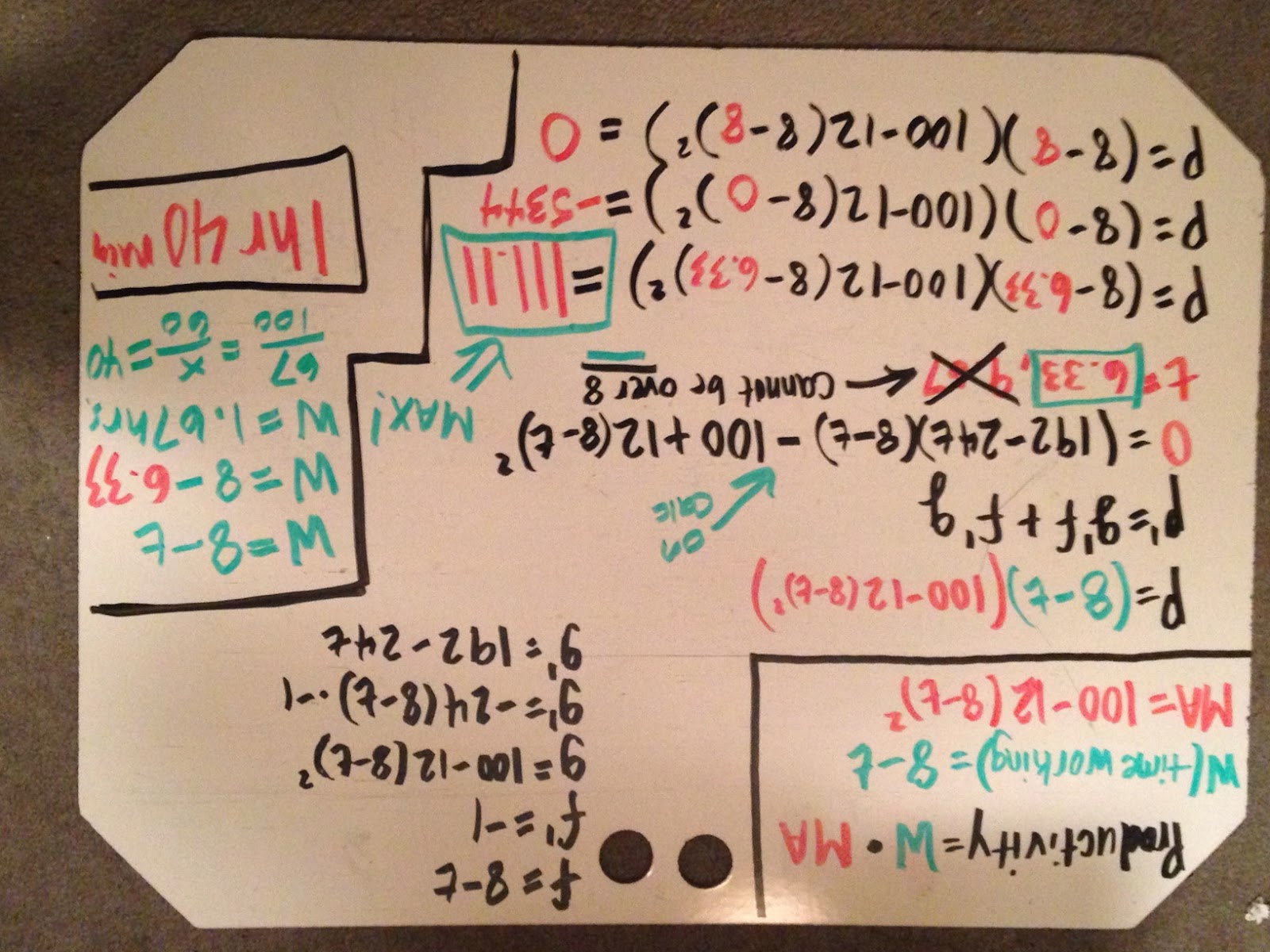
However, I wanted to share this picture:
IMG_1627.JPG

This is work a student did for her weekly reflection. She did it on a whiteboard and then pasted an image of this into the Google Doc we share together. This is her very own whiteboard- I got a new set last summer and relegated my old ones to the backup squad (because I couldn't bring myself to junk them completely). When some of my students commented on the new boards, I told them the story. They clamored to be allowed to take the old boards home- they love doing work on them! Heart warming, I tell you what!


By the way, if you're wondering about the optimization problem I made up, it's pasted below...


A person’s productivity, P, can be modeled as the product of their mental acuity (MA) and the time that he or she spends working. A graduate student in advanced mathematics is busy 16 hours of the day, so she has 8 hours that can be devoted to either sleep or work. The problem is that the amount of sleep she gets drastically affects her mental acuity. She has monitored her daily output and believes that her mental acuity is best modeled as MA=100-12*(8-t)^2 where t is the amount of sleep she gets every night. She has been working so hard that her mental acuity is at an all-time low, so she needs your help to determine how much time she should spend working to optimize her output.

If you’re stuck, she feels like she would probably start by writing down an expression for the amount of time she spends working in terms of her free time and the amount of time she spends sleeping.


And yes, for those intrepid readers, I do realize, courtesy of one of my students, that my MA function implies that mental acuity will peak at 0 hours of sleep. Quite the oversight- I'll do better next year. Speaking of mental acuity as a function of time spent sleeping...

Monday, September 28, 2015

Saving time and sharing

Morning! This is going to be a quick post just to share something new I recently learned. I've been using OneNote for more than a year now in lieu of Smart Notebook. OneNote has some quirks, but it does a much better job of keeping me organized. And the newest reason I love it is because I realized I can give my students viewing privileges for the class notes/discussion. No more exporting pdf's and emailing them to absentees or posting them to the website- it's all there in a single link. So excited, especially because so many students have been traveling lately to do awesome things.

Also, check out Genius Scan. It can insert images directly into OneNote (with a purchase). I really like it for getting student work up in front of the class in an anonymous way, especially when we run out of time and have to pick up the following day (darn those short periods!).

Secondly (and finally), I gave a presentation at the Fall Institute for the Global Teacher Fellowship about my journey to Australia. If you're interested, you can find it here.

Cheers!

Friday, July 24, 2015

Day 9: Melbourne High School and Albert Park College

Yesterday I visited Steve Draper at Melbourne High School and Jane Coyle at Albert Park College.

The daily schedule at Melbourne High School is more similar to what my own school runs: seven 43 minute periods every day. The school is an all-boys school and is selective entry, so students take an exam to get in. Most enter in year 9, but the occasional student enters in the latter years. There seems to be a strong emphasis on marks and scores from the get-go, and Steve told me that sometimes it can be frustrating when the students are more focused on the grade they get than learning the material. I actually think that the Victorian scheme of assessing students puts a stronger emphasis on underdstanding that the NYS Regents- the year 11 course is basically a dry run for year 12 and it's relatively low stress. 

I observed a physics 12 class on electric power and transformers. Steve did some awesome demos including melting nails and solder. The students were really engaged by this. Then I observed a year 11 prac (lab), during which the students were looking at the I vs. V curve for a globe (light bulb). They were using a different experimental setup than I employ for this sort of activity: breadboards, variable resistors, and a single 9V battery. I usually do it via the Modeling-esque version of batteries and bulbs, which has the students build a simple circuit and then add additional batteries. I can't get the same fine scale for really small voltages, but in terms of setup and data collection it goes faster. It was really interesting to see the same activity I do executed a different way. Finally, I observed a year 12 maths methods course (by the way, NEVER call it math here). It was about binomial distributions, and their teacher was pushing them well past the content that they're likely to see on the state test and into confidence intervals. Neat stuff.

After my visit Steve and I went for coffee with Dan O'Keefe. We had an interesting discussion about the nature of education and how schools can best prepare students. Steve made an interesting point about how the current educational system is basically a remnant of a different time and we're headed for a vastly different future. He recently attended an edutech conference (http://www.edutech.net.au/and mentioned that the skills employers most want out of graduates are adaptability and creative problem solving abilities. I agree wholeheartedly and think that it's high time that traditional education be re-imagined.

Speaking of which, this leads me to my visit with Jane Coyle at Albert Park College. Albert Park is a state-run school and is not selective entry. It is a very new school- the current year 11 class is the first cohort to go through. The school has such a strong reputastion that people have begun moving to the area just so that their children can attend it. This is actually a bit of a problem, as the space is not quite big enough for the extra classes that have been added. It puts a strain on the staff and the building.

The facilities are really nice: large open spaces and small tables for group work. All the students bring their own device to class every day, so there is no need to have permanent desktops around the room. The school has an excellent set of Vernier equipment which it puts to good use with lots of student-centered activities. Jane also uses a flipped style, but it's not just straight videos. Her students are also expected to do reading assignments outside of class, but Jane stressed that the reading quizzes she administerers via Google Forms are just for comprehension/completion, not to check to see if they fully understand everything. That role is saved for clas time. Periods are 60 minutes and students generally meet 4 periods a week: two singles and a double.

The Year 11 double period I observed on a Friday afternoon was remarkably focused and the students had a lot of energy. They worked Newton's second law problems in small groups and then worked on an Atwood prac. It was nice that they all had electronic access to the writeup sheet and instructions so they could start their reports right then and there (Google Sites).

There are 7 girls taking year 11 physics out of a total of 31. There were 4 in the class I observed, and I asked them if they were going to continue on next year. Two of them said they will definitely take year 12 physics. The third said maybe- she seems to struggle a bit with the content. The fourth is trying to decide between physics or a pre-university course that she can earn university credit for taking.

Jane and I had a great discussion about why so few females take physics in Australia. This was actually the focus of her Masters work, so she was very well informed! Her research, which involved surveying female students in maths methods courses, found that:

  • The female students analyze prerequisites for university and know what they need to take. Then they focus on those courses. Since physics isn't a prerequisite for any university courses of stud, they generally dont take it [though this limits their options if they don't end up pursuing medicine]
  • A strong indicator of whether or not female students will study physics is a connection with someone who knows science- usually a family member
  • Seeing another female who has studied science or teaches science also increases the liklihood that they will study physics
  • Finally, exposure to a career that employs physics- especially an altruistic career or one that involves helping people or society such as Engineers Without Borders- increases the liklihood that girls will study physics

Jane works very hard to be visible and get to know the younger students in an effort to grow the school's physics enrollment. It is already the highest of the co-educational schools I visited, but she sees a lot of room for improvement. Our research interests are very similar and we had a terrific discussion.

The day ended with an interesting lecture at Melbourne University and then a farewell dinner with Dan, Colin, Jane, Barbara, Neil, and Paul Cuthbert. It has been a fantastic trip and my mind is reeling from everything I've seen- can't wait to implement some of these great ideas next fall! I'd like to formally thank all of the teachers who invited me into their schools, answered my endless questions, and made me feel right at home. I'd also like to recognize that none of this would have been possible without the support of the Rural School and Community Trust- thank you for making this journey happen! 

Thursday, July 23, 2015

Day 8: Ivanhoe Girls' Grammar School and Billanook College

Today I visited two Pauls: Paul Fitz-Gerald at Ivanhoe Girls' Grammar School (IGSS) and Paul Fielding at Billanook College. A common thread between the two, aside from a mild geographical proximity, was the Space Camp they run in the summer. Students from both schools spend an entire week during their holiday break learning about aerodynamics and flight first hand. They go for a flight in a glider and also in a plane, launch model rockets, and design their own gliders. The camp looks fascinating- wish I could get all of my students together for a week in the summer to do something like this!

Before I forget, Paul Fielding showed me a really neat camera called a Key Cam that uses a micro SD card and is affordable enough to be attached to a rocket. The footage is remarkably good and the unit is affordable enough that it's not the end of the world if it doesn't survive the landing.

I observed a year 10 class at IGSS that was studying inertia. Well, actually a pair of them running simultaneously with different stations, and the students moved back and forth between the rooms depending on which experiment they were working on. The teachers (Paul and Dina) had planned this out ahead of time and it seemed to go really smoothly. The activities were engaging and were presented in the form of real-world scenarios- pushing a heavy shopping cart, collisions between cars, etc. 

Many teachers here, like as Dina, Giselle, and Paul Fielding, were actually engineers first before becoming teachers. The undergraduate degree doesn't matter too much- the teachers either got a one-year postgraduate diploma in teaching or a masters afterward. The diploma is being phased out and the only option for new teachers will be the masters route.

Billanook College feels like it's far removed from the city, but it just happens to have a large campus (with its own stream) and be situated next to a vineyard. It's an independent school, but it doesn't have an entrance exam, so it gets a wide economic cross-section of students. It has strong support services for students with learning disabilities and also for international students. One faculty member told me that while the campus is nice, their strength is in the programs they offer. The school has a day with five 65-minute periods on a 2 week rotation.

I observed a year 11 class that ran like a well-oiled machine. The students were running motion labs using inclined planes and trolleys (carts). They collected data via the Pasco Spark Systems. The only hiccup, which was really minor, was the transfer of the graphs to the students' Google Docs writeups. They have to take a picture with their device (iPads for years 7-9, BYOD after that (laptop and phone/tablet) and then insert it into google docs via drive. It worked fine and the students had an excellent handle on using the devices after having them for so long. Side note: Paul Fitz-Gerald's school had an interesting way to let the students know the expectations for how iPads were to be used during the lesson:

Too few students at my school use devices in this manner, so it's not really applicable, but I liked the idea.

There was 1 female student out of two classes that total roughly 22 students. Paul Fielding told me that the state average is 20% female for year 11's, and 10% for year 12 courses.

After school Paul took me to the top of Mount Dandenong, which was spectacular. We then had dinner with his wife, a linguist, and the school's career counselor. It was fascinating to hear their perspectives. 


Wednesday, July 22, 2015

Day 7: John Monash Science School and NVSES at Monash University


Today I visited Barbara McKinnon at the John Monash School for the Sciences (JMSS). It was unlike any other school I've visited- anywhere. It's a select entry school focused on the sciences. Students come from the area around the school, but they also have a program where students from rural schools attend remotely for most of the year and then come in person to spend a 3-week stint at the school. 
The layout of the school was groundbreaking when it first opened, and it's still fairly unique (more on that in a moment). The layout is very open, to the point where there are classes going on simultaneously on either side of a “bridge” without any dividers. This means that there is always some background noise from other classes, even in the enclosed classrooms and labs. Part of this is due to the glassed-in separators between the rooms, but the other reason for it is due to the class sizes. Every period is essentially a double period and is either 70 or 75 minutes in length. There are 4 periods in a typical day, unless it's Wednesday, when there are only 3. The students spend Wednesday afternoons doing extracurricular activities and the staff have professional development.  A normal class is 50 students and is team taught by two teachers. One usually takes the lead while the other circulates and answers questions that crop up without interrupting the flow of the rest of the class. This seemed to work remarkably well, but there was a lot of background noise. The pros of this model are numerous and have been documented by Greg Lancaster of Monash University. One of the biggest positives that Greg noted during our discussion was the continuity if a teacher happens to be absent: their partner can simply step in and teach the lesson with the support of someone else filling in. This also means that the pair can divide the lessons so that each teaches the material they feel most comfortable with. 

The students at JMSS are very focused, and that's what makes this model works. One student told me that the noise can be distracting at times, but that she really likes the model with two teachers and the open classrooms. This was echoed by many students, who also enjoy taking classes with other dedicated students with s genuine interest in science. The open model has been tried at other schools, with what I understand to be limited success. Students who are apathetic toward their studies or tend to have behavior issues can take advantage of the freedom the model offers to goof off or misbehave. The biggest issue JMSS appears to face in terms of discipline seems to be attendance issues with students who aren't as dedicated as they ought to be, and subsequently getting these students caught up. Missing a 70 minute lesson is challenging to make up, especially when the students have very full schedules. Speaking of which, they take approximately 7 different courses: math, a core science, an elective science, English, humanities, language, and gym. Languages are either French or Japanese (nearly positive that this is the case, but to be honest the schools visits are blending together a bit at this stage, so take that with a grain of salt).. The range of courses that are under the umbrella of humanities is somewhat surprising: they include environmental science and IT courses. 

A standard teaching load is 4 courses plus extra duties. Since the courses are team-taught, this prep load is slightly better than it appears at first blush. Also, it is mandated that all of the sections of a particular course stay in sync and use a similar approach. This keeps the students on the same page, but decreases the flexibility allowed to individual teachers. As one student noted, it gives extra prep time for tests because the test cannot be administered until all of the sections have completed the material, but it also means that feedback is delayed because the test is not returned until all of the students enrolled in the course have taken the assessment. It can be 2+ weeks before students find out their scores on a test. 

On a side note, you being such intrepid readers have probably noticed a distinct dearth of students in my photos. This is not accidental, but rather because there are strict rules here about getting permission before publishing photographs of students. Given the extraordinarily short nature of this trip, it wasn't feasible to get the suitable permission so I am only able to share images of teachers and their classrooms. Barbara told me that the students and teachers would be very comfortable with my coming and going, and this was certainly the case. They were also very comfortable answering questions, both about the content they were learning, the process of learning, and how their experience at JMSS compares to their previous schools. 

This is already a long entry, but there is more to come. This is possibly the most applicable bit too, because it involves rural students. The original goal of my fellowship was to visit schools in rural areas similar to the region I live in back in the United States. Dan O’Keeffe from Vicphysics was instrumental in setting up my itinerary, and he sent an invitation to their mailing list of teachers asking for volunteers to have me come visit their schools. Nobody from rural schools responded, and after arriving I learned that many rural schools simply do not teach physics because they do not have a teacher who knows the content. This explains why I haven't been able to visit rural schools!

The program at JMSS for rural students is pretty unique. Two teachers sit in a recording studio and have class with students who are connected remotely from all over the state. The ideal setup is for the students to attend in real-time, but the videos are published to an unlisted youtube channel for students to review if they happen to miss class. This is a good way for students in remote areas to get access to material that they would not otherwise be able to learn. 
Today while I was chatting with Simon Tyler, one of the teachers at JMSS, he said that my name sounded familiar. Turns out that he recognized it from the Global Physics Department! Small world...

I had lunch today with Greg and a visiting researcher. We had a great discussion about how to make good videos for education and what it takes to do that from a pedagogical perspective. Among other things, Greg works on a project called the National Virtual School of Emerging Sciences.  Fascinating stuff- perhaps the model of remote delivery could work for small rural schools in America? In NY we'd have to sort out how to handle the hands-on lab component, but it certainly has potential. It would take some work to do it right though.

I liked the look of this building on Monash's campus:


Tuesday, July 21, 2015

Day 6: Buckley Park College, VSSEC, and Vicphysics

Today I spent the morning with Neil Champion at Buckley Park College. Buckley Park is a state run school in a suburb north of Melbourne. It has an accelerated group of 25 students who compete to be admitted, but I didn't have the opportunity to observe these students. Instead, I observed several different classes: the tail-end of a year 10 class, a year 12 class, and a year 7 class.

The students were quite welcoming and Neil gave me ample opportunity to talk with them. Curiously, the thing they were most interested in discussing was accents, which I found quite interesting. Several students were astonished to learn that, to my ear, they have accents. When I spoke with the younger students I got the chance to ask them about their future plans in science. Several students I spoke with didn't plan to continue studying science after year 10 because they didn't think that their careers would need it. I asked for an example and it was business or law. Another student who wants to be a midwife was unsure if she would need science (I suggested biology would be a good starting point). Other students thought they'd take chemistry, but just because it was the next thing to do, not because it was of particular interest. 


The year 10 class was a mixture of boys and girls, the year 12 course has dwindled to 6 boys and 1 girl, and the year 7 was 14 boys and 10 girls. The seating in the year 7 class was curious- many of the boys chose to sit close to the back while the girls sat toward the front. One of the girls said that the exact opposite thing occurs in some of the other courses- the boys sit toward the front. She wasn't sure why this phenomena happens. 

Neil said that for the year 12 students the females seem to enroll in the course only if they're confident that they can handle the material, while more of the boys take it without really thinking it through and consequently end up dropping the course. 

Neil has had an extensive career in education in a variety of different roles. He has worked as a teacher, administration, textbook writer, and also in curriculum design. He was one of the authors of the textbooks his students use, which were really interesting in that they are hybrid. This means that the students have paper copies but also electronic access, not only to the textbook but also to the website with associated worksheets and simulations.

This afternoon I went to visit the Victorian Space Science Education Centre, which is typically abbreviated as VSSEC. This is a facility similar to GTAC, in that its mission is to use space as a vehicle to get kids interested in science. They have programs for students in years 3-12, and will soon add programs for the three younger years as well. They have programs for students to come to the center and experience working in mission control or as astronauts. They also have water rocket programs for younger students. Another notable thing is that the fees for the students depend on the type of school they're coming from: students from economically disadvantaged or rural schools come for free. There are also outreach programs where VSSEC staff take lessons to classes, frequently giving them equipment and lessons. VSSEC serves approximately 13,000 students each year.

To be honest, by this point in the day I was, to put it in the local vernacular, "knackered." I took a lot of pictures of the facility and was overwhelmed and impressed by everything they do. The Mars room was incredible and I wish I had a facility similar to this to take my students to experience. 

I'll leave you with the pictures and field any questions you have- leave them in the comments below and I ought to get a notification.


Finally, this evening I attended the monthly Vicphysics meeting. It was great to see a group of professional teachers working together to improve their craft and help other teachers. This reminds me of the Western New York Physics Teachers' Alliance, which I wish were closer to me!

Monday, July 20, 2015

Day 5: Camberwell Girls' Grammar School

Today I visited Giselle Lobo at Camberwell Girls' Grammar School. CGSS is located in Camberwell, which is an eastern suburb of Melbourne. It's an all-girls school, and remarkably this was the first time I have had the chance to observe female students since I arrived in Australia. In one school I visited previously the female students happened to be in a different period than the one I observed, but in the other schools the female students simply do not choose to study physics. I have been quite surprised by this, but CGGS certainly doesn't have a problem getting its students to study physics. There are two year 11 sections and two year 12 sections. Giselle has the dubious honor of teaching both year 12 maths (methods) and years 10-12 physics. Teaching a year 12 course here in Australia is both an honor an a large responsibility- they generally require a lot of work due to the VCE exams at the end of the year.

CGGS is in the midst of a large renovation. It appears that it will be a great addition to the school, but at the same time it was distracting to the students to have the construction noise right outside their classroom. So much so that Giselle moved her afternoon class to a different location. She didn't have access to all of her equipment in the new location, but the students didn't complain about the noise like they did in the earlier section. The first classrom was a large physics classroom with lab equipment and an lcd projector. The second classroom had a whiteboard and two large televisions that Giselle connected her iPad to using Airplay.

The first class I observed was year 12 students who were learning how to apply the right hand rule. They were thrown by some of the symbols the textbook used- labeling a dot as point "X" is confusing if you're trying to figure out whether the electric field is coming out of the page or going in! (For non-physicists: a vector coming out of the page is represented as a point (tip of the arrow) and going in is an x (end view of the arrow with fletchings, usually with a circle around it)). The students were engaged and remained remarkably focused given the din outside the door.

After lunch I observed one of Giselle's colleague's math 12 courses in methods. In general methods is sort of the middle route - specialist is more difficult calculus and there is a third option, but to be honest I can't remember what it even is. This class was reviewing the content of their recent SAC Exam (school assessed component). Each student's final grade in the course is a weighted average of their score on the state-authored VEC exam and a series of exams that are administered and scored by the school, which are affectionately called SAC's. The students didn't have their own exams in front of them because the exams haven't been completely scored yet, but they seemed to remember the majority of the material. It was calculus- anything from integration and sums to related rates. To be honest I was surprised by how deep this course went into the content- makes me think that the specialist course probably hits well above the AP bar I'm accustomed to.

The final class I observed was Giselle's year 11 students, who were working on motion problems. They learned this material last year during year 10, but they only have one quarter of physics (10 weeks), so they didn't get terribly far into it. Today's lesson was probing for what they remembered and required them to utilize multiple representations of motion- moving from a written description to graphs of position, velocity, and acceleration vs. time. They had the general gist of it but had some difficulty deciding whether line segments on velocity graphs should be straight or curved. This led to an interesting discussion of how realistic they needed to be when modeling motion. The class was using the Conceptual Understanding Procedures (CUPs) materials from Monash University. These seemed similar in intent to the Modeling Curriculum I use and I liked them a lot. 


The whiteboard at the end of class. There was another version of the top-left velocity graph with negative signs in place of the red positive marks representing increasing slope, but it got erased before I could snap a picture.

Sunday, July 19, 2015

Weekend Expeditions

Amos invited me to spend with weekend with him and his family in Torquay, where they live outside of Geelong. It was great to revert back into a "normal" lifestyle instead of the wandering vagabond theme I've been enjoying lately. On Saturday we took his son on a walk/bike ride to the park and then spent the afternoon at a footy match (the Geelong cats even won!).

Yesterday we went surfing and I managed to catch a few waves. 

Then it was off on a drive down the Great Ocean Road to look for Koalas, which we eventually found.


Also saw kangaroos at dusk, but by then my phone battery had died so there isn't any photographic evidence. It was a busy weekend but also an excellent interlude before I dive into the coming week, which is jam-packed with school visits and events.